What a PTO budget is really for
Your budget is a plan for the whole school year. It tells the board how much you expect to raise, what you expect to spend, and what’s left for the things your school community cares about most.
It’s also your decision-making tool. When a teacher asks for $300 for classroom supplies in March, the budget is how you know whether you can say yes.
What belongs in a PTO budget
Most PTO budgets are built from the same core pieces:
- Starting balance. The money carrying over from last year.
- Income. Every expected source of money, listed by line: each fundraiser, membership dues, donations, and grants.
- Program and event expenses. Teacher appreciation, field trips, assemblies, family events, and classroom grants.
- Fundraiser costs. What it costs to run each fundraiser, listed separately from what it brings in.
- Fixed costs. The bills that show up no matter what, like bank fees, insurance, payment app fees, and website or email costs.
- Reserve. A cushion set aside so next year’s board doesn’t start at zero.
Where PTO budgets go wrong
The structure is simple. The numbers are where it gets hard:
- Budgeting fundraisers at their best year ever. One great year isn’t a forecast. If you plan around the record, every normal year looks like a shortfall.
- Counting gross instead of net. A fundraiser that brings in $5,000 but costs $2,000 to run is a $3,000 fundraiser.
- Forgetting the fixed costs. Insurance renewals and processing fees don’t feel like spending until they hit the account.
- Starting without real records. If last year’s treasurer didn’t leave clean numbers, you’re building on guesswork.
- Skipping the reserve. Spending everything you raise feels generous, but it leaves next fall’s board scrambling.
Getting it approved
Once your draft is ready, present it to the board with a short explanation of any big changes from last year. Check your bylaws, too. Many PTOs require the general membership to vote on the budget, not just the board.
Once it’s approved
A budget only helps if you compare it to what actually happens. That comparison, budget vs. actual, belongs in every monthly treasurer report. It’s how the board spots a fundraiser running short or an expense running over while there’s still time to adjust.
Why a generic budget template falls short
Most free budget templates are built for households or small businesses. They don’t separate fundraiser income from fundraiser costs, they don’t track budget vs. actual month by month, and they don’t make it easy to hand the whole thing to next year’s treasurer.
A PTO budget template should match how PTO money really moves, so planning in August and reporting in March use the same system.
Ready to build a budget your board can actually follow?
If you’re building this year’s budget
PTO/PTA Annual Budget Template
An editable Google Sheets budgeting system with 9 connected planning and tracking tabs, built-in formulas, and a treasurer setup guide covering annual budget planning, board presentation, monthly habits, and year-end handoff.
See the Budget Template →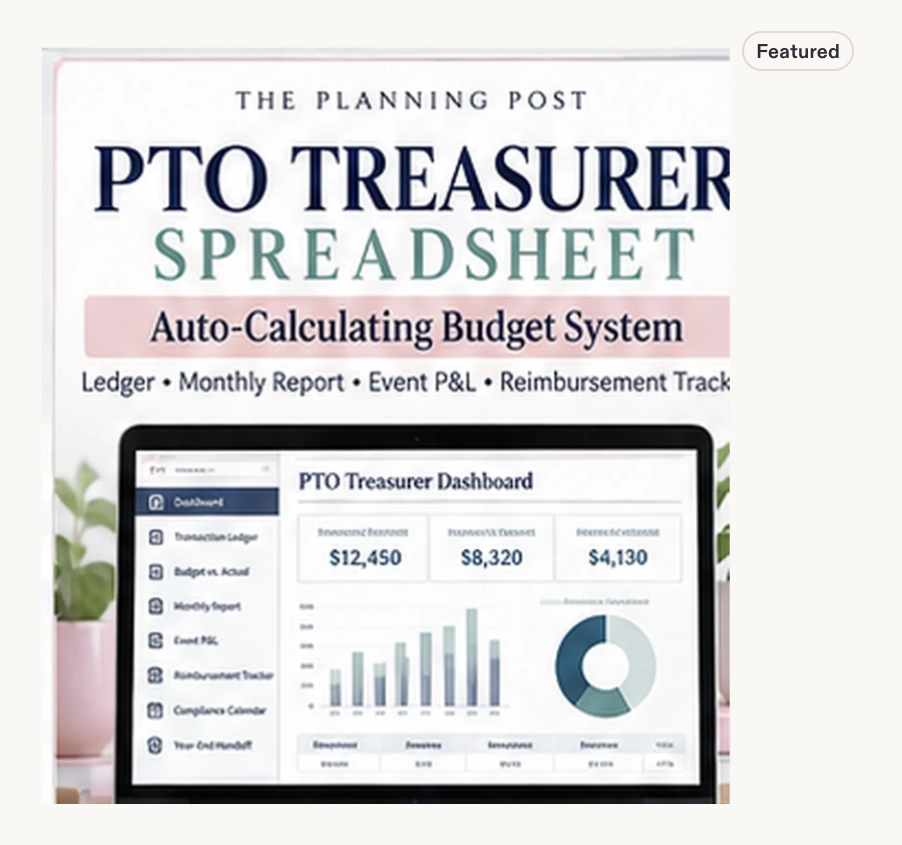
If you want to track every dollar all year
Treasurer Spreadsheet for PTO/PTA
An auto-calculating Google Sheets system with a transaction ledger, budget vs. actual, monthly report, event P&L, reimbursement tracker, and year-end handoff checklist.
See the Treasurer Spreadsheet →